News & Updates
The Body & Brain Benefits of Creatine Monohydrate
One of the most rigorously tested supplements in the history of medicine costs less than a postage stamp per day, and has been proven to be just as good for your brain as it is for your body.
★ KEY TAKEAWAYS ★
Creatine Monohydrate Is:
- Very safe: Creatine monohydrate is almost chemically identical to the naturally occurring organic creatine produced in the human body and found in animal/seafood proteins. Over 680 peer-reviewed clinical trials since the '70's have shown that creatine monohydrate is not associated with clinically significant side effects, with rates no higher than in placebo groups.
- Inexpensive: A single daily 5g dose of Momentous Creatine (which uses premium Creapure® ultra-purified creatine) costs less than 50 cents. (Save when you buy any Momentous products online with code "Chatham".)
Key Benefits:
- 💪🏼 BODY ➔ Proven effective at improving body composition - especially when combined with resistance (strength) training. Particularly effective for populations who face increase risk of sarcopenia (muscle mass loss) and osteopoenia (bone mass loss), such as 50+ adults, post-menopausal women, GLP-1 users, and vegetarians.
- 🧠 BRAIN: Short Term ➔ Shown to improve short-term cognitive performance — especially under stress or poor sleep. This effect is most evident with higher dosages.
- 🧠 BRAIN: Long Term ➔ Showing significant promise in emerging research as a tool to protect the aging brain against dementia. Again, this effect is most evident with higher dosages.
How to Use:
- Odorless and flavorless (though a bit chalky to some).
- Standard dose is 5g/day. Higher doses up to 30g/day (or ~0.3–0.35 g/kg body weight) have been proven safe, but aren't always necessary.
- Mix with 8oz. or more of water, juice, sports drink, or into smoothies or coffee. Consume within 30 minutes for maximum benefit.
- "Loading" isn't necessary, but has been shown to accelerate muscle creatine saturation. If you follow the standard 5g/day protocol, you should notice increased energy / reduced fatigue while training within a couple of weeks, and noticeable gains in strength, power, and recovery speed as creatine stores reach optimal levels after 3-4 weeks. These effects can be accelerated by starting with a 5-7 day "loading phase" where you take 20g/day, split into 2-4 doses throughout the day, and then drop down to the standard 5g/day dose. But this loading phase isn't necessary, and is no longer universally recommended.
⚠️ Note ➔ Consult with your doctor before taking creatine - especially if you have a pre-existing kidney condition or might be pregnant.
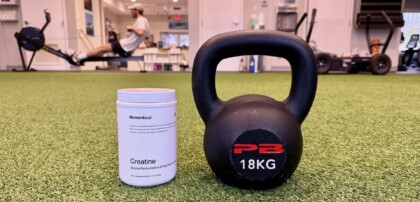
Safety First: Creatine monohydrate is one of the most extensively studied — and safe — supplements in existence.
Creatine is a naturally occurring organic compound that we produce in our bodies, and obtain from eating animal/fish proteins. Creatine monohydrate consists of a creatine molecule bound to one water molecule, and is ~90% pure creatine by weight. It is almost chemically identical to the creatine your body produces, and obtains when you eat meat or seafood.
Creatine monohydrate's safety record is exceptional by any standard. Over 680 peer-reviewed clinical trials have been conducted on creatine supplementation since the 1970s, involving over 12,800 participants given doses up to 30 grams per day. No clinical adverse events were reported in any of those trials, and minor side effects were infrequent and not significantly different from participants consuming placebos in those same studies.
Persistent concerns about kidney damage, cancer risk, and dehydration don't hold up under scrutiny: available research does not support a link between creatine supplementation and cancer, and studies consistently show no adverse effects on renal function in healthy individuals. In fact, creatine may actually reduce the incidence of muscle cramps. (source: Frontiers in Nutrition, April 2025)
The most common side effects are temporary water retention and mild GI discomfort, both of which are dose-dependent — gastrointestinal distress is reported by some individuals at higher doses but is not universally experienced. Splitting your daily dose into two smaller servings can help. One practical note: creatine raises urinary creatinine on routine bloodwork, which is a normal metabolic consequence of supplementation — not a sign of kidney damage — but worth flagging to your doctor before labs.
★ BODY COMPOSITION BENEFITS OF CREATINE ★
Creatine has been proven to produce meaningful, measurable improvements in body composition - particularly when combined with resistance training.
Creatine monohydrate doesn't just add bulk — it increases lean tissue while reducing body fat. A large systematic review and meta-analysis found a significant increase in fat-free mass of 0.82 kg, while studies using creatine monohydrate with a maintenance dose also showed a significant reduction in body fat percentage.
A more recent 2025 meta-analysis of 61 controlled trials found even larger gains: creatine significantly increased fat-free mass by 1.39 kg and body mass by 0.89 kg, with trained individuals gaining up to 1.82 kg of fat-free mass compared to 1.23 kg in untrained participants. (source: Journal of the International Society of Sports Medicine, December 2025)
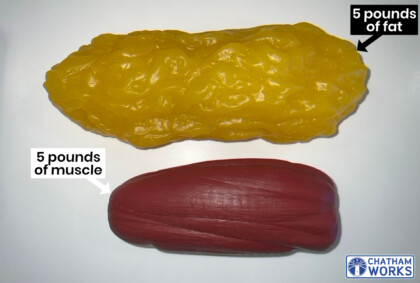
If you lose 5 pounds of fat and gain 5 pounds of muscle, your weight (and therefore your BMI) will remain unchanged. But you'll be stronger, fitter, look and feel better, and your basal metabolic rate (the rate at which you burn calories while sedentary) will increase from having greater (metabolically demanding) muscle mass. (Get detailed insight into - and track - your body composition by having an InBody Scan.)
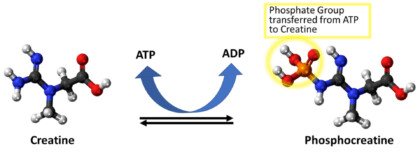
How It Works - Body Composition Improvements
Creatine monohydrate works by replenishing phosphocreatine stores in muscle, which are the body's fastest fuel source. Creatine enhances exercise performance by increasing muscle phosphocreatine stores, which facilitates rapid ATP resynthesis during high-intensity activities. This higher training volume/intensity, leading to greater hypertrophy over time.
Creatine also draws water into muscle cells, which increases measured lean body mass (LBM). This can also make your muscles appear "fuller". The increase in LBM due to water isn't purely "muscle protein", but true muscle accretion occurs with consistent resistance training. (source: Frontiers in Nutrition, July 2025) (photo source)
SPECIAL USE CASE: GLP-1 Users
GLP-1 medications can cause 25–40% of total weight loss to come from lean mass (including muscle) in many studies, especially with rapid/large weight loss, low protein intake, or minimal exercise. This risk may be higher in older adults and postmenopausal/perimenopausal women due to accelerated sarcopenia and osteopenia risk. (sources: Sage Journals, Scientific American)
A 2025 peer-reviewed narrative review on dietary supplement considerations during GLP-1 therapy found that meta-analyses in adults aged 50–80 show the creatine group increased lean body mass by an average of 1.32 kg compared to placebo when combined with resistance training — and that creatine remained effective even when taken on training days only for improving lean tissue. (source: Frontiers In Nutrition)
Doctors are increasingly recommending that patients on GLP-1's participate in resistance training to help them preserve muscle mass and bone density. (sources: The Journal of Nutritional Physiology, Obesity Pillars)

Understand and track your body composition by taking an InBody Scan.
SPECIAL USE CASE: Vegetarians
The case for creatine monohydrate supplementation is particularly strong for vegetarians and vegans, because meat and seafood are the primary dietary sources of creatine.
The deficit is real and well-documented. The foundational evidence comes from a frequently cited 1989 study which established that normal reference values for creatine, creatinine, and carnitine are measurably lower in vegetarians compared to omnivores — a finding consistently validated across decades of subsequent research. More recently, a 2025 randomized controlled trial confirmed that vegetarians have ~17% lower baseline muscle creatine than omnivores, and that a 7-day loading protocol increased total muscle creatine by ~30% in vegan and vegetarian participants.
Multiple studies - including two from 2025 - have found that the cognitive benefits of creatine supplementation are more significant for vegetarians/vegans than for omnivores, because vegetarians/vegans have lower creatine brain stores to begin with.
Additional Population-Specific Studies Related to Creatine and Body Composition
★ COGNITIVE & BRAIN HEALTH BENEFITS OF CREATINE ★
Creatine has been shown to meaningfully sharpen short-term cognitive performance — especially under stress or poor sleep.
The brain runs on the same phosphocreatine energy system as muscle, and it responds to supplementation. A 2024 systematic review and meta-analysis of 16 randomized controlled trials found that creatine monohydrate supplementation produced significant positive effects on memory, attention time, and information processing speed across healthy individuals and clinical populations.
The benefits are strongest when cognitive demands are highest: a 2025 randomized, double-blind, placebo-controlled crossover trial found that a 7-day creatine monohydrate loading protocol improved subjective sleep quality and enhanced cognitive performance in physically active men, suggesting benefits well beyond its traditional ergogenic role.
Emerging research suggests Creatine may help protect the aging brain against dementia.
The creatine energy system is directly impaired in Alzheimer's disease, making supplementation a logical therapeutic target. The landmark 2025 CABA (Creatine to Augment Bioenergetics in Alzheimer's) pilot trial from the University of Kansas Medical Center — the first human clinical trial of its kind — tested 20 g/day of creatine monohydrate for eight weeks in 20 patients with probable Alzheimer's disease, finding it feasible and associated with bioenergetic and cognitive improvements.
A 2026 follow-up study from the same team confirmed that creatine monohydrate may mitigate bioenergetic failure in Alzheimer's disease by supporting ATP buffering and modulating mitochondrial function — two hallmark deficits of the disease.
While these are early-stage findings, they represent the first human evidence for creatine's potential role in Alzheimer's treatment.