News & Updates
The AMAZING Mental & Brain Health Benefits of Exercise (updated)
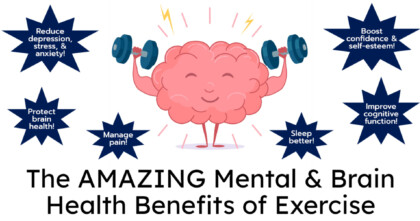
(This article updates our October 2022 piece of the same title.)
Key Takeaways:
★ Exercise rivals medication and therapy for depression and anxiety. Multiple large-scale reviews of randomized controlled trials confirm that exercise is comparable to — and in some cases more effective than — antidepressants and psychotherapy for relieving symptoms of depression and anxiety. Exercise can also help prevent them.
★ All types of exercise help, but some stand out. Aerobic exercise (running, swimming, cycling, dance) appears most effective for depression. Resistance training may be especially beneficial for anxiety. Supervised and group exercise settings tend to produce the greatest improvements.
★ You don't need to do a lot. Research suggests that even modest amounts of physical activity — well below federal guidelines — can meaningfully reduce the risk of depression. And even shorter-duration programs (8–12 weeks) can produce significant results.
★ Exercise physically changes and protects your brain. Physical activity triggers the release of brain-derived neurotrophic factor (BDNF) and other neuroprotective compounds that promote new brain cell growth, improve memory and cognition, and reduce the risk of Alzheimer's and Parkinson's diseases.
★ Exercise improves sleep, which is foundational to mental health. Meta-analyses of randomized trials consistently show that regular exercise significantly improves sleep quality, sleep efficiency, and total sleep time.
★ Only about 1 in 4 U.S. adults get enough exercise. Despite the overwhelming evidence, just 26.4% of American adults meet federal guidelines for both aerobic and muscle-strengthening activity.
As far back as Hippocrates, healthcare practitioners have extolled the belief that exercise is medicine.
It's commonly understood that regular physical activity can dramatically reduce risks associated with cancer, heart disease, high blood pressure, stroke, type II diabetes, and numerous other diseases. It has also long been accepted that exercise has profound benefits for our mental health.
What has changed in recent years is the sheer weight of evidence behind that claim. A surge of rigorous research — including several landmark meta-analyses — has made the case stronger than ever: exercise is one of the most powerful tools we have for protecting and improving mental health.
Yet according to data from the CDC's 2024 National Health Interview Survey, only about 26.4% of U.S. adults meet federal guidelines for both aerobic and muscle-strengthening activity. Less than half (47.2%) meet the aerobic guidelines alone.
So to mark Mental Health Awareness Month, here's what the latest science tells us about why that needs to change.
NOTE: We are not suggesting that exercise should replace professional treatment for clinical depression or anxiety. But the evidence strongly supports exercise as an effective complement to medication and therapy — and for milder symptoms, it may be a powerful first-line intervention on its own.
#1: Exercise can be as effective as medication and therapy for treating depression and anxiety. It can also help prevent them.
A landmark 2023 umbrella review published in the British Journal of Sports Medicine — led by researchers at the University of South Australia and encompassing 97 systematic reviews, over 1,000 randomized controlled trials, and more than 128,000 participants — concluded that physical activity is highly effective for improving symptoms of depression, anxiety, and psychological distress across a wide range of populations. The effects were comparable to, and in some analyses slightly greater than, those of antidepressant medication and cognitive behavioral therapy (Singh et al., Br J Sports Med, 2023).
In February 2026, a new umbrella review and meta-meta-analysis by Munro et al. — also published in the British Journal of Sports Medicine — reinforced these findings, concluding that all forms of exercise examined performed as well as, or better than, medication and talking therapies for depression and anxiety, regardless of age or sex (Munro et al., Br J Sports Med, 2026).
That 2026 review also offered some useful specifics:
- Aerobic exercise (running, swimming, dancing) appeared most effective overall for relieving depression and anxiety symptoms.
- Supervised and group exercise settings were associated with the greatest reductions in depression — an important finding for anyone who exercises with others in a gym, studio, or class setting.
- For anxiety specifically, shorter-duration programs (up to 8 weeks) and lower-intensity exercise appeared most beneficial.
A separate 2024 umbrella review focused on adults with diagnosed depression (published in the Journal of Affective Disorders) found that exercise produced a moderate-to-large effect on reducing depressive symptoms, with a "number needed to treat" of just 2.78 — meaning that for roughly every three people who exercise as an intervention, one will experience a clinically meaningful improvement.
It's also worth noting that exercise helps prevent depression, not just treat it. Earlier research published in JAMA Psychiatry in April, 2022 found that regular physical activity is associated with a roughly 25% lower risk of developing depression in the first place.
In a poll conducted by the American Dental Association in March of 2021 (in the midst of COVID shutdowns), 71% of dentists reported seeing a marked uptick in people grinding and clenching their teeth - a condition often associated with stress - and 63% cited an increase in patients with chipped and cracked teeth.
How/Why Does Exercise Help?
Some of the specific ways exercise can help with depression, anxiety, and mood include:
- Neurochemical changes: Exercise triggers the release of endorphins, endocannabinoids, and other mood-regulating neurotransmitters (more on these below).
- Increased confidence and self-esteem: Meeting exercise goals — even small ones — can boost self-confidence. Getting in shape can also improve how you feel about your body and capabilities.
- Greater social interaction: Exercise and physical activity — and especially group exercise classes — provide opportunities to connect with others, form new relationships, and strengthen existing ones. Social connection is itself a powerful buffer against depression.
- Healthy coping: Doing something positive to manage difficult emotions is inherently healthier than dwelling, isolating, or turning to substances.
#2: Exercise supercharges and protects your brain.
Research has shown that regular exercise can markedly improve cognitive functions: the ability to think, recall, focus, and make quick decisions. It also helps protect our brains from neurodegenerative diseases like Alzheimer's and Parkinson's.
A key mechanism involves a molecule called irisin, a myokine released by muscles during exercise. Irisin crosses the blood-brain barrier and boosts levels of brain-derived neurotrophic factor (BDNF) in the hippocampus — the brain region that governs learning, memory, and spatial navigation, and one of the first areas affected by neurodegenerative disease.
BDNF promotes the growth of new neurons, supports synaptic plasticity (the brain's ability to form and strengthen connections), and helps existing neurons survive. A 2023 review in Biomolecules (Jaberi & Fahnestock, McMaster University) detailed how exercise-induced increases in BDNF, irisin, and other compounds like osteocalcin and lactate work together to protect against Alzheimer's-related cognitive decline (Jaberi & Fahnestock, Biomolecules, 2023).
A 2025 review in Frontiers in Neurology further confirmed that physical exercise increases BDNF levels — particularly in younger adults — and explored how different types of exercise (aerobic, resistance, and combined) modulate BDNF differently in people with neurodegenerative diseases (Romero Garavito et al., Front Neurol, 2025).
➔ The bottom line: exercise doesn't just make you feel better today. It physically strengthens and protects your brain for the long term.
💡 Exercise has also been shown to help manage ADHD: a 2023 umbrella review published in eClinicalMedicine (a Lancet journal) found that physical exercise significantly improves cognitive function, mental health, and core ADHD symptoms — including attention, hyperactivity, and impulsivity — in children and adolescents with ADHD (Liang et al., eClinicalMedicine, 2023).
#3: Exercise helps you sleep better, and sleep is critical to mental health - and the functioning of virtually every biological system and process in your body.
Getting adequate sleep is critical to our physical and mental health. Sleep enables proper brain restoration, memory consolidation, cell repair, and the removal of toxins from the brain. It's also essential for regulating hormones that control stress, appetite, growth, and immune function. Yet according to the CDC, roughly 1 in 3 American adults don't get enough sleep (7+ hours a night).
⏾ If you exercise regularly but don't make sleep as much of a priority, you're spinning your wheels. Sleep is "where the magic happens" - it's critical to the functioning of the immune system and maintenance of proper hormone levels, including:
- Melatonin, which helps promote sleep.
- Growth hormone, which supports bone and muscle development as well as metabolism.
- Cortisol, which is part of the body’s stress response system.
- Leptin and ghrelin, which help control appetite.
Exercise is one of the most effective non-pharmacological interventions for improving sleep. A 2024 network meta-analysis of randomized controlled trials published in Frontiers in Psychology analyzed multiple exercise types and dosages and found that moderate-to-high intensity exercise significantly improved sleep quality. The review found that mind-body exercise (yoga, tai chi), resistance training, and aerobic exercise all produced meaningful benefits (Li et al., Front Psychol, 2024).
A 2025 network meta-analysis in BMC Public Health — encompassing 86 randomized controlled trials and over 7,200 participants — similarly concluded that multiple forms of exercise improve sleep, with combined aerobic-and-resistance training, yoga, and pilates ranking among the most effective approaches.
Earlier research published in Sleep Medicine reported that people with short sleep duration who exercised at moderate intensity four times per week gained an extra 75 minutes of sleep per night — more than any sleep medication has been shown to deliver.

#4: Exercise Triggers Powerful "Feel-Good" Brain Chemistry.
While exercise initially activates the body's stress response, after bouts of physical activity people experience lower levels of stress hormones like cortisol and epinephrine. A 2025 network meta-analysis of 44 RCTs published in Sports confirmed that exercise significantly reduces cortisol levels in people experiencing psychological distress, with yoga and mind-body practices showing the greatest effects (Li et al., Sports, 2025).
For years, the positive mental effects of exercise were largely attributed to endorphins. But more recent research has shown that endocannabinoids — the body's own natural version of the active compounds found in cannabis — deserve much of the credit.
A 2023 systematic review published in The Neuroscientist examined all clinical trials on endocannabinoid levels following exercise and found that 14 of 17 studies detected an increase in endocannabinoids after acute exercise. The review concluded that exercise-induced increases in endocannabinoids are associated with key features of "runner's high" (including reduced anxiety and increased euphoria), and also have analgesic properties because they help to reduce pain perception. This is one reason exercise is increasingly recommended as a non-pharmacological approach to managing chronic pain (Siebers et al., The Neuroscientist, 2023). A 2024 study further confirmed that both major endocannabinoids (AEA and 2-AG) significantly increased after a 60-minute outdoor run, along with measurable improvements in mood (Weiermair et al., Sports, 2024).
Endocannabinoids bind to receptors in the amygdala and prefrontal cortex — regions that regulate the stress response. When endocannabinoid molecules lock into these receptors, they reduce anxiety and promote feelings of calm and contentment. They also increase dopamine in the brain's reward system, fueling feelings of optimism and motivation.
A 2023 comprehensive review in the International Journal of Molecular Sciences described how the endocannabinoid system is involved in brain plasticity, learning and memory, inflammation, appetite regulation, energy balance, and emotional regulation — and that physical exercise is one of the most effective ways to activate it (Forteza et al., Int J Mol Sci, 2023).
A Final Thought ...
The research connecting exercise to mental health has never been stronger or more consistent. From massive meta-analyses confirming its effectiveness against depression and anxiety, to molecular studies revealing how exercise physically remodels and protects the brain, the evidence points clearly in one direction: regular physical activity is one of the most important things you can do for your mental health.
And the benefits compound. A growing body of research supports the idea that positive behaviors reinforce more positive behaviors — that exercise, social connection, sleep, and purpose can work together synergistically to enhance well-being and ward off cognitive decline.
You don't need to train for a marathon, and you don't need a gym - though there are many great reasons to come to a place like Chatham Works! A brisk walk, a group fitness class, a bike ride, or a few sets of strength exercises — done consistently — can make a meaningful difference. The hardest part is starting. But the science is clear: your brain will thank you.